

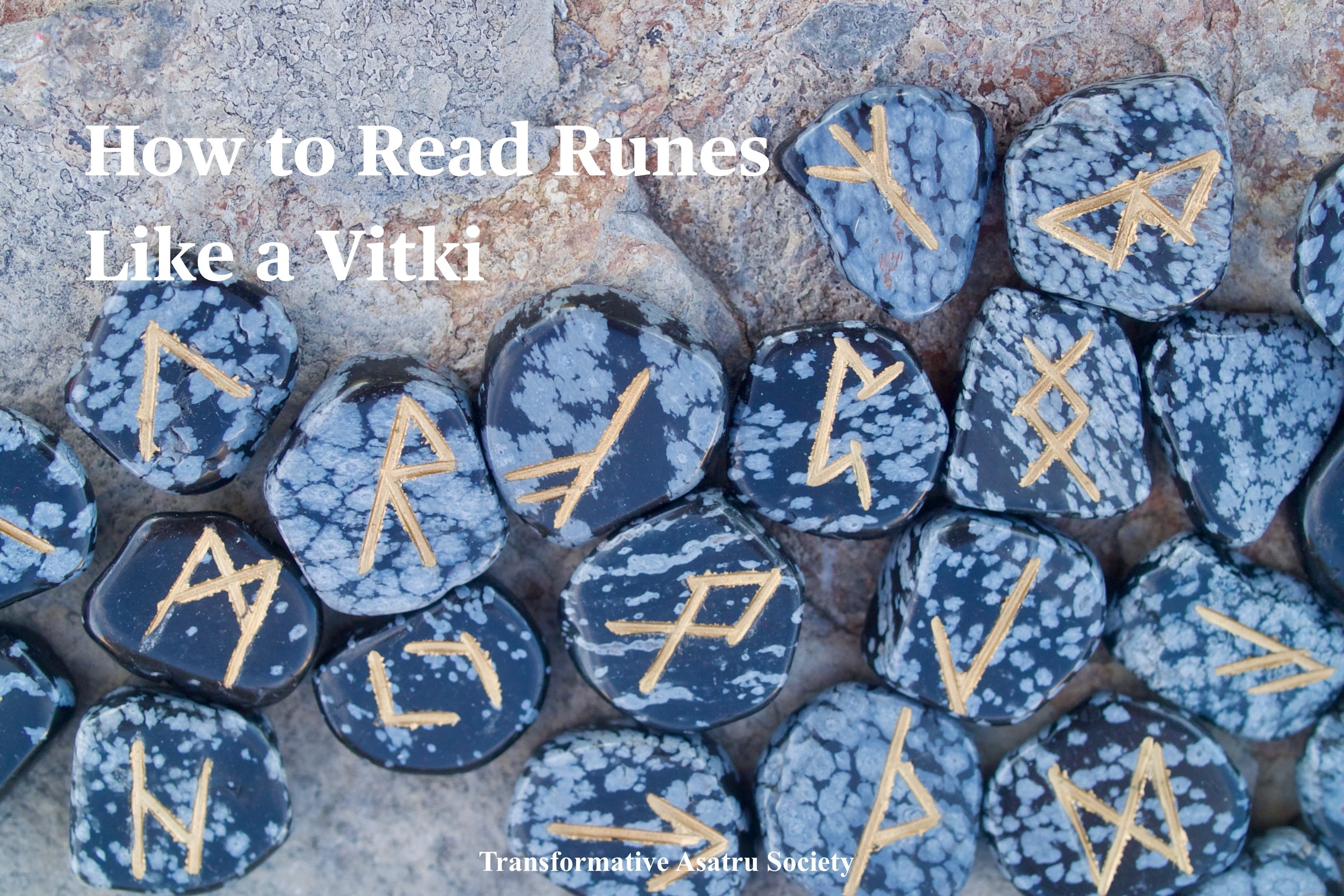
When we refer to the Northern Mysteries as an independent branch of the world’s variety of esoteric disciplines, we refer principally, if not exclusively, to the runes: an ancient script shrouded in mystery with origins rooted deep in the history of the Northern European peoples.
The word rune literally translates as “mystery.” This ancient writing system and the lore surrounding it stand at the center of our practice. Runes come in neatly arranged sets of 18, 24, or 33 that are easy to memorize and simple enough to draw or carve for anyone with a little motivation. The barrier to entry is so low, in fact, that a reasonably intelligent person could be writing passable runic inscriptions with a good scraping tool and as little as a few hours of careful study.
Many would-be magicians, or vitkar, to use the Old Norse term, begin by studying the basics of runes but quickly abandon the endeavor, for it soon becomes obvious that their meaning and power run far deeper and are far more complex than originally thought. The study of this handful of skeletal characters launches from a gentle foothill to a precipitous mountain face, perhaps more starkly than any other known esoteric system. And the more of this face we attempt to scale, the fewer directions are available.
For anyone who has not already spent years steeped in the study of runes, they can feel daunting. These images are dense with history and layered with myth, demanding equally intellectual discipline and practical skill. Indeed, it is often recommended that, given a choice, the runes should not be one’s first esoteric or divinatory system.
Nonetheless, as daunting as this system may be, it is ours as the European-descended peoples of the world.
Anyone who follows Ásatrú, or any other living pagan tradition, is by definition an occultist as well as one of sincere religious belief. He is drawn toward that which is hidden, that he might discover it, and toward that which is forbidden, that he might be free.
This is one of the major philosophical differences that separates a truly “Pagan” worldview from the mainstream religions of the modern world, especially the Abrahamic ones. Those traditions generally discourage esoteric practice beyond the simplest forms of devotion, while restricting their most sublime teachings to a priestly class who must intercede for the masses. Pagan religions, by contrast, at least those in the form they take today, must necessarily place the common faithful in direct contact with the living, holy powers, for they are understood to represent an absolute birthright. Various practitioners, shamans, mystics, and others with particular talents and abilities have always been a part of pagan communities and, when genuine, they are a precious and invaluable asset to the seeker on his quest. But who has the right to claim sole spiritual authority to stand between a man and his ancestors and interpret their words? For that is exactly what pagan gods are. They are our ancestors, our kin, our family. Their blood flows through our veins, and their life force is inseparable from our own.
If there is to be a pagan priesthood, then its legitimate role is to facilitate, never to mediate or dominate. Such invasive behavior is that of an interloper, not a spiritual guide.
Such a system of spiritual development provides broad freedom, but also demands accountability. The ordinary worshipper must continually aspire to a firmer grounding in lore, culture, metaphysical reality, and, most importantly, direct experience than most in contemporary society. We could never have found this path without being men and women of learning, nor had the wherewithal to set out upon it without the aptitude to experience it completely.
We need not all become specialists. As the military saying goes, no matter his specialty, every soldier is a rifleman first. The infantry, a minority of the modern force, go further, making a whole career of the profession of arms, while a very few elite special forces refine the craft further still. Every Ásatrúar should naturally begin as something of an occultist, while a rare few will find themselves compelled to make extensive occult study their life’s work. Each of us must discover how far we are destined to go and map out how we will get there.
Rune work tends to be a layered discipline. Competence arrives when the practitioner can move effortlessly between the letter, the sound, the image, and the living intelligence. It is a long, organic process of deep learning that can be neither rushed nor faked - at least not very well to those who have put in the work. This discussion will attempt to demonstrate that progression by dividing the work into three deliberate stages. There will be no time requirement for any phase, nor a final exam, nor special recognition for having completed any part. This is the first lesson in magick: we are accountable to ourselves. Progress is instead measured by ease of operation. When the tasks of one stage become natural, nearly automatic, it means we have thoroughly absorbed and become one with it. We will know we are ready for more when we hunger for it.
PHASE ONE: SETTING OUT
Before even attempting to learn the names of the runic letters, the beginner should seek a sturdy foundation. A general familiarity with the body of lore concerning the gods of Asgard and the mythic universe they rule is the perfect place to start. Some familiarity with the history of the Germanic peoples and the ancestral homelands that produced these tales is useful as well. Learn these stories, and develop an intuitive sense for the personalities they describe. Internalize them, and make them your own, so that you can revive the oral tradition that once gave them life. These stories will teach you about the gods, so that one day soon you will come to know them personally. They will also help you make critical insights and associations in the runes, so that the meanings will easily fall into place when you contemplate them. Over time, everything you do with them will come alive.
When you begin to take up the runes, you will work almost entirely under guidance. This is ideally done under the supervision of a teacher, but can be self-taught with some personal discipline by availing yourself of the many primary and secondary source texts in circulation today. Such books are abundant, and there is never such a thing as too much reading for a beginner.
Endeavor to become conversant in the various runic systems throughout history. This will form the skeletal structure of your knowledge base. Seek out primary sources, especially the original rune verses, and fully absorb them. Make them your own. Treat them as sacred text, for that is exactly what they are.
At this point, you will be ready to take in the standard scholarly treatments of the rune names and their poetic meanings. At this early stage, do not attempt to add original interpretation; there will be plenty of time for that later. Instead, master the standard meanings until they’re ready at hand.
With that foundation in place, it should seem natural to want to try your hand at runic writing. No need for ceremony; just start doing it. Memorize the staves and phonetic values of the system you have chosen. (The Elder Futhark is most commonly the set used for magick, but for native English speakers, the Anglo-Saxon Futhorc is highly recommended for writing).
Practice writing or carving personal names and short, inscription-worthy mottos until the staves flow from the hand without hesitation and the need for the source text eventually fades. As you do this, pay attention to style. Spell phonetically according to the sound of the language being written, rather than the habits of modern English spelling. Avoid double letters; for example, use a single stave for any doubled consonant or vowel. Keep inscriptions short and declarative, such as: “I __ write these runes,” or “__ stands here.” More complex formulae can wait until later, and you’ll know when it’s time to use them.
Esoteric practice at this level is limited because of the intellectual rigor of learning the basics of a new system. However, just as there is no formal exam, neither is there any fixed point where reading ends and practice begins. Rote memorization is every bit as much of an occult practice as astral projection.
That said, there is practical work to do immediately. You must begin integrating them into your psyche as thoroughly as your digestive system turns food into flesh. Sit quietly and form a clear mental image of a single rune, holding its shape fixed in the mind’s eye until it stays there without concentrated effort. Allow the mind to settle, relaxing while the image remains of its own accord until it naturally fades. It will feel very much like relaxing a muscle after strenuous work. This is an elementary trance state that gradually imprints the runes onto the surface of the subconscious, while priming the body and mind for deeper meditation. The longer the image remains without strenuous concentration, the more deeply rooted the connection. Try it. It works.
Preliminary energy and elemental work at this stage will make things much easier later. Additionally, an established meditation practice should be considered an absolute prerequisite. In an age blessed with an abundance of information, accurate information on how to learn these techniques is widely available. Find a practice that suits your constitution and practice it daily. It will have a cumulative effect on all aspects of your life.
For those with little prior experience with energy work, the classical body postures known as staða may be used as an aid to moving life force tangibly through the body. Such practices are optional, but very helpful. What matters most is that the rune begins to live in the mind and body as more than a mere letter.
No divination is undertaken yet, no objects are charged, and no formal ritual is performed. Attempted prematurely, such operations will feel perfunctory, even downright silly. Whenever a sense of awkwardness arises, obey it. It means something else needs to be integrated first. It’s always better to set some minor aspect aside for a while than to reach the point at which the silliness sours into contempt. You will know the foundation is complete when the writing of names and simple inscriptions has become accurate and effortless, when the shapes and traditional meanings arise easily in the mind, and when the basic practices of visualization and meditation feel natural. As easy confidence emerges, you can honestly say that you have made the runes truly yours. They have become “native” to you.
PHASE 2: CLAIMING OWNERSHIP
At a certain point during all of this work, the runes will have become as readily accessible as common speech. They will have been made “native” in the sense that they will be heard in the speech of others, and the learned associations that accompany them may even rise unbidden in the ambient sounds of nature. A bird, a river, a rustle of leaves, or the patter of rain might seem to “speak” in a way that would have been ignored before. Gradually, a profoundly intelligent natural world emerges from the din of the ordinary. This kind of enhanced perception signals emerging potential as a diviner.
We may notice also that we interact with this world naturally and instinctively in surprisingly magical ways, such as how we might reflexively intone “ah” (•ᚫ•) when a new idea strikes, or “ooh” (•ᚢ•) when someone is hurt. Noticing quirks like this shows a potential for galdr, the active side of rune magick, especially that which deals with vocal projection. An appetite to match the aptitude means you’re ready to take a more dynamic approach.
The traditional meanings sit ready in the mind, and the simple acts of visualization and quiet attention feel as ordinary as breathing. You stand at the threshold of what might be considered an intermediate stage in your journey. From this point, though they will never be entirely uncoupled, scholarship and practice will begin to see less of each other. Here, someone with purely academic interest will bow out, as the work grows more intentionally “occult.” What was once a matter of memory and rote association now, through a growing reserve of experience and original insight, becomes more like a conversation. It is somewhat like learning a foreign language. First we learn some vocabulary and grammar, and then seek out opportunities to practice them.
The outward signs that most associate with rune magick appear here as well. The rudiments of banishing and hallowing a ritual space will be one of the first things to master. This space, cleared of competing influences, is where it will make sense to experiment with binding staves for a particular effect, and with drawing lots to answer a question. A gradual acquisition of physical ritual implements belongs here as well, for those so inclined.
Not everything will land perfectly into place. If there is no resistance, reassess how much of the material you are actually taking in. But if practice at this level feels ungainly, it is a sign of growth. Before we adopted formalized practices, we needed to set ungainly things aside; now we must embrace them, trusting that their importance will reveal itself with time. They mean new pathways are being made, and should be reinforced often. Do not cut corners when following a prescribed ritual, and do not add extraneous steps to a ritual you create, but work with the certainty that every last detail serves a purpose.
A third possible sign of trouble is the occasional taboo that may arise. Photographing consecrated items or recording live rituals, for example, might generate a repellent magnetic feeling, as if someone unwelcome is being invited to look where they ought not. With social media especially, this is literally the case. If something feels viscerally wrong, as if some unseen guardian were trying to warn of imminent danger, this will be closer to the truth than may be apparent at first. If something triggers this response, heed it.
After learning and internalizing the shapes and their conventional meanings, it will seem natural to want to bind them together into tidy monograms. The stave shapes lend themselves intuitively to this practice. Here, there is no harm in experimenting. Crafting bindrunes helps save room on an inscription when space is limited, and may also form sigils for an augmented symbolic effect. It’s a process of condensing individual ideas, truly living universal principles, into focused statements of intent and words of power. A runic formula represents an act of pure will, reduced to its most essential geometry.
Practice first by combining staves that already speak clearly to one another. Some will fit like puzzle pieces; others will clash or need to be coaxed; a certain few will disappear entirely into their mates, and these are the luckiest of all. Carve or draw them slowly, speaking the names aloud, until the composite figure feels alive. Over time, the hand learns which combinations hold tension and which resolve into something stronger than their parts.
With the capacity to manipulate runic ideas by binding comes the first formal approach to divination: the passive, receptive counterpart to galdor’s assertive command. For this purpose, a set of runes carved into a medium of choice will quickly become a steadfast companion.
Start small. A single rune for daily contemplation, or three for a clearly articulated question. The answer to a three-rune pull is traditionally read as one from each of the three principal Norns: past, present, and future, or more precisely, “what is,” “what is becoming,” and “what should come.” Another way to think of it might be in the context of a sentence: subject-verb-object, or simply the actor, the action, and the thing being acted upon. Reading this way triples the range of information you can collect, leading to a far more detailed and precise reading.
Gradually, external reference material becomes less necessary. Don’t throw away the books, but let trust in your own expertise take center stage. During a rune pull, listen for a change in the quality of the silence and note the way that change settles or unsettles the mind. You might begin to notice that the runes answer less in the language of the waking intellect and more in the language of the subconscious. First comes the flash of the image, then an immediate sense of an underlying mood, followed by a sudden association and a corresponding shift in the body. Pay attention to where the body stirs and treat that information as living intelligence. Here, the runes emerge as beings in their own right.
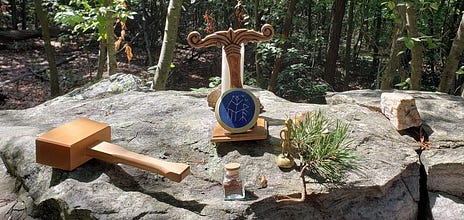
Alongside the increasingly intricate practices, many will feel the quiet need to gather the tools of craft, and the weapons of ritual magick. Certain articles of ritual garb are likely to follow, especially if the path happens to be leading toward a more public or vocational role. The specific nature and arrangement of these holy items belong to another discussion, but let it suffice to say that the need for any given piece tends to announce itself in the course of the work and that, quite frequently, the piece itself is liable to come into your possession under mysterious circumstances.
Prefer sacramental items that are handmade, found, gifted, or honestly repurposed. Purchase them only as a last resort, but if you must, favor antiques and other well-worn implements that have already lived a life of their own over mass-produced novelties. Tools obtained in this spirit tend to answer more readily, almost as if they already have personalities of their own. However, if gathering implements feels premature or irrelevant, leave it alone for now. Ritual items are meant to be assistants rather than the central focus of the work. The runes themselves must always remain the primary instrument.
The culminating work of this intermediate stage should be the production of an original prose commentary on each rune. Here, your own accumulated hoard of expertise is put to the test. This commentary will remain grounded in tradition, never contradicting what lore has been long established, but will advance the state of the art with the new insights that have arisen through your own practice. It will be the record of a living conversation between a master and his trade.
When you can write such a commentary without strain, the intermediate work is reaching its fulfillment. You will know the moment by the same signs that marked the end of the beginning stage: ease, and the quiet hunger for more.
PHASE 3: TO RULE
When a thought grows, it stays in motion. It returns time and time again, as if by tide, to the forefront of consciousness. And while it remains in motion, it costs but a small amount of energy. When the thought grows into a great body of knowledge, as it does with a study of the runes, it creates a vast field of motion that consumes a great amount of mental power. It will block further progress, resisting refinement until it is discharged. To write it down is to release it. This is why every book and essay written on the runes is the record of a magician who has left something behind of their psychic load so that something finer could take its place.
This is why at least once, at some point mid-career, indeed possibly several times in your life, you have to attend to your own commentaries in like fashion, whether or not you ever intend to publish them. When the prose commentary stands complete you have finally taken that critical step. You have claimed authority. What follows is to exercise rule.
To rule, in the sense intended here, is to assume the long, exacting labor of making one’s own will so transparent that it becomes indistinguishable from the Divine Will as expressed through the holy powers.
The one who reaches this realization commands the runes so far as he allows the gods to command this world through him. Even as the runes, being the primordial principles undergirding all reality, command the gods themselves, so aligned, the vitki of the runes is paradoxically both the master and the instrument of divine decree.
At this level, you will weave the runes into formal ritual with ease. The introductory disciplines combine into a self-supporting whole. A ritual is no longer assembled from parts, but arises as a coherent act of will in which the parts complement one another.
Divination and augury should never feel ordinary, but they will have become familiar practices, well-worn pathways, oft traveled and easy to trust. You may have also learned through experience more complex methods than the standard pull of three runes as circumstances should call for. With increasing confidence, you may have additionally experimented with combining runes with other divinatory systems such as numerology, bibliomancy or astrology - subjects of which you will have doubtless picked up to a greater or lesser extent.
As a man or woman of letters, by this time you have learned not to treat the Northern Mysteries as if they were hermetically sealed. Rather, they hold a place of honor among the world’s retinue of wisdom traditions, which, throughout history, have influenced and communicated with one another in the common pursuit of perfect knowledge. If this is your goal. Occultists of every stripe and creed are your colleagues in The Work. The runes are your weapon of choice, but that doesn’t mean you don’t know how to pick up others. Like the Allfather, you have gone far and wide in your study, absorbing wisdom from a wide array of the world’s mystery traditions, and have used that ever-broadening base of knowledge to make yourself more cunning.
Parallel to knowledge and experience, visionary work deepens accordingly. Your power of visualization opens into a controlled form of inner journeying that some might honestly call second sight. This power is akin to the active imagination described in Carl Jung’s Red Book, but without the guardrails of an academic framing. By a method of your choice, you enter a receptive yet alert state and allow the runes (or, more precisely, the beings who stand behind them) to present themselves in living image, in voice, or across a landscape suited to their nature. Far from fantasy, this is a disciplined parlay with the unseen, undertaken with the same accountability that has governed every earlier practice you have mastered. You go, you listen, you watch, and you copiously record everything you encounter, leaving out no detail nor injecting any editorial commentary. Over time, the boundary between what you think you are imagining and what you are in fact encountering grows thinner, until the two begin to inform each other without effort.
As a mark of mastery, you should at this stage compose an original rune poem in the tradition of the rune verses of old. Where the intermediate magician you once were produced prose commentary, the vitki you have become through your visionary questing is ready to communicate as it was communicated to you, in the pure language of experience.
A true rune poem is a serious magickal working. Each stanza must carry the traditional weight of the stave, while speaking with the authority of the practitioner’s own revealed gnosis. The effect broadens the state of human knowledge, much like an explorer returns to his home port with an expanded map and a log filled with new discoveries. The poem becomes both an offering and an instrument. A gift to the tradition and a tool that can be used, like a map, to return to parts previously unknown. Poetry of this order is more difficult than prose, precisely because it leaves no room for the merely explanatory. Every word must come alive, every passage must invoke.
All of the earlier practices continue uninterrupted, now carried with the ease of long familiarity. The tools of your trade are present, but you have learned that they are merely external aides to an internal process of transformation. Though they are helpful, you know with a certainty that you can do the magick without them. The ritual garb is so much like a second skin that it has created an imprint, an invisible mantle you can wear at will without physically donning the cloth. Your commentaries never end, but are revisited and deepened as the state of the art advances with you at its forefront. Nothing is discarded, even if you discover your younger self was wrong. Everything is a record of your quest.
There is no final examination, and you should not expect public recognition. Nor should you want such attention if it does not serve the Work. It is now the time to rule, and no true king has ever been impressed by fawning servants.
The Work does not end. It simply continues. And by keeping faith with the deeper order you serve, and faithfully continuing your study and practice, eventually, in this life or another, perfection is quietly attained, and the accomplishment of The Great Work is achieved.
This is the way of the seeker, the initiate, the vitki. It is not an easy path, nor does it make for an easy life. Quite the opposite, actually. But for those of us who have traveled it, and continue to do so, there was no other course of action we could have pursued.
The door is open to you, and it always has been.
To follow us, or not to follow us.
The choice is yours.
The path - The Great Work - awaits.
Thank you for sharing!