
Among the world’s trove of esoteric disciplines, the Northern Mysteries form a distinct current. This current is related to the much more thoroughly explored Western mystery traditions, similar in both attitude and, to an extent, appearance. However, though related, it cannot be fully accessed by treating it simply as a cultural extension of Hermeticism, Gnosticism, Qabalah, or any other discipline under the broad Western classification. Writings derived from these traditions often don’t know what to do with runes or the Germanic mythic framework, other than to mention that they exist and that there may be some correspondences worth considering.
The Northern Mysteries do indeed share correspondences with the Western, but they stand upon their own foundation, growing directly from the folklore, myth, and ancestral worldview of the Nordic and Germanic peoples. They are a related but distinct set of practices, for a related but distinct breed of humanity.
Because both Northern and Western traditions address the same fundamental realities, many of the methods of one will appear familiar to the other. The resemblances are genuinely useful, to the extent that they can inform and supplement one another. Yet the Northern stream has its own mythic grammar, giving it a distinct character that will depart in certain ways — some quite consequential. One oft-cited example is the reversed gender polarity between the Sun and the Moon. Western tradition follows the Mediterranean and Middle Eastern model of a solar masculine and lunar feminine, while Northern traditions hold a “Man in the Moon” god and refer to the Sun in the feminine; a small but critical distinction for anyone attempting to wrap planetary attributes into a runic working.
As a modern-day discipline, the northern Mysteries are also comparatively young. This can present both a limitation and an opportunity. The classical Western traditions have had centuries to codify their tools and garments, the Tau robe being a readily observable example. In such a long-standing tradition, none need fret over what to wear, as it is spelled out with great specificity.
The Northern Mysteries offer no equivalent standardization. There is no fixed pattern for ritual dress, nor a universally accepted set of proportions or materials. Thus, a gathering of Western magicians will project a certain uniformity in their ecclesiastical raiment. By contrast, an assembly of Northern ones, not unlike a Viking crew of old, will look like what they are: a motley collection of wizened travelers, adorned with the spoils of adventure and armed for the foray ahead.
One may, of course, adopt the outward appearance of an early medieval Northman, but such a choice privileges historical costume over living function. We are a famously practical people. We use what we have, acquire what we need, and give away what we don’t. If an item or article serves no purpose, it tends to get bartered away or thrown out. If a historical costume serves to invoke the current, use it. If not, it is distracting you from the true Work and making you look unserious.
Whether the garment or the tool actually serves the work is a question that only experience can answer. Because the Northern current in this century is still emerging, the practitioner must assume the role of a pioneer. Tradition must be held tightly in one hand, careful experimentation in the other. Ritual implements and garb are rarely selected from a pre-approved catalog; more often, they announce themselves through the unfolding of the path, and to that end, a sense of two-way communication develops between the worker and the articles the path begins to require. The fact that those articles will tend to all follow a common underlying logic in their form and function, therefore, says more about the fundamental, metaphysical reality being approached than it does any doctrine or whim.
An item destined to be used for magick is likely to arrive by magickal means. An object may sit unnoticed for years until the Work reaches the precise point at which it suddenly becomes necessary. At that moment, it silently announces itself. A certain coat may have haunted the closet for decades unnoticed; a certain cup inherited; a wand suddenly revealed in the branch of a specially important tree. When it is time for these things to be adopted, they are recognized rather than merely chosen.
This level of individual freedom resonates strongly with the Germanic blood and spirit, but it carries with it a corresponding danger. Once magickal implements are charged, they acquire a seeming magnetism of their own. The more we work with them, the stronger that pull becomes. Anyone who has ever consecrated a blade or blooded a set of runes can surely attest to that magnetic pull, and will have a hard time denying that the effect is, just a little bit, addictive. The effect intensifies when the Work moves into the creation of secondary items, tokens, wards and all the smaller dedicated pieces that naturally arise from ongoing practice. To be surrounded by such loudly silent things in a closed space, not to put too fine a point on it, can be a rather “spellbinding” experience.
It is possible to spend years filling shelves and drawers with an ever-growing collection of consecrated objects, all the while slowly drifting away from the discipline’s actual goal. Many who fall into this pattern sincerely believe themselves advanced practitioners, when in reality they have simply driven themselves crazy. They have become entangled in secondary processes to the point of obsession, perpetually brooding over an expanding hoard of bits and bobs and odd bric-a-brac that no longer serves the primary work. It feeds the cycle of an ever more unstable, deteriorating mental condition. Your relatives will thank you for not leaving behind a house full of cursed garbage.
We are moving through open territory, much of it deliciously uncharted. The absence of rigid prescription is a genuine freedom, but that freedom demands of us a built-in sense of discernment, as serious as trying wild mushrooms. Our task is to remain true to our heritage as inventors and explorers without becoming hoarders of emotionally laden debris. The sacramentals must remain physical aids to the true goal of spiritual perfection; never a substitute for it.
Cosmology and the Ritual Space: A Proposal
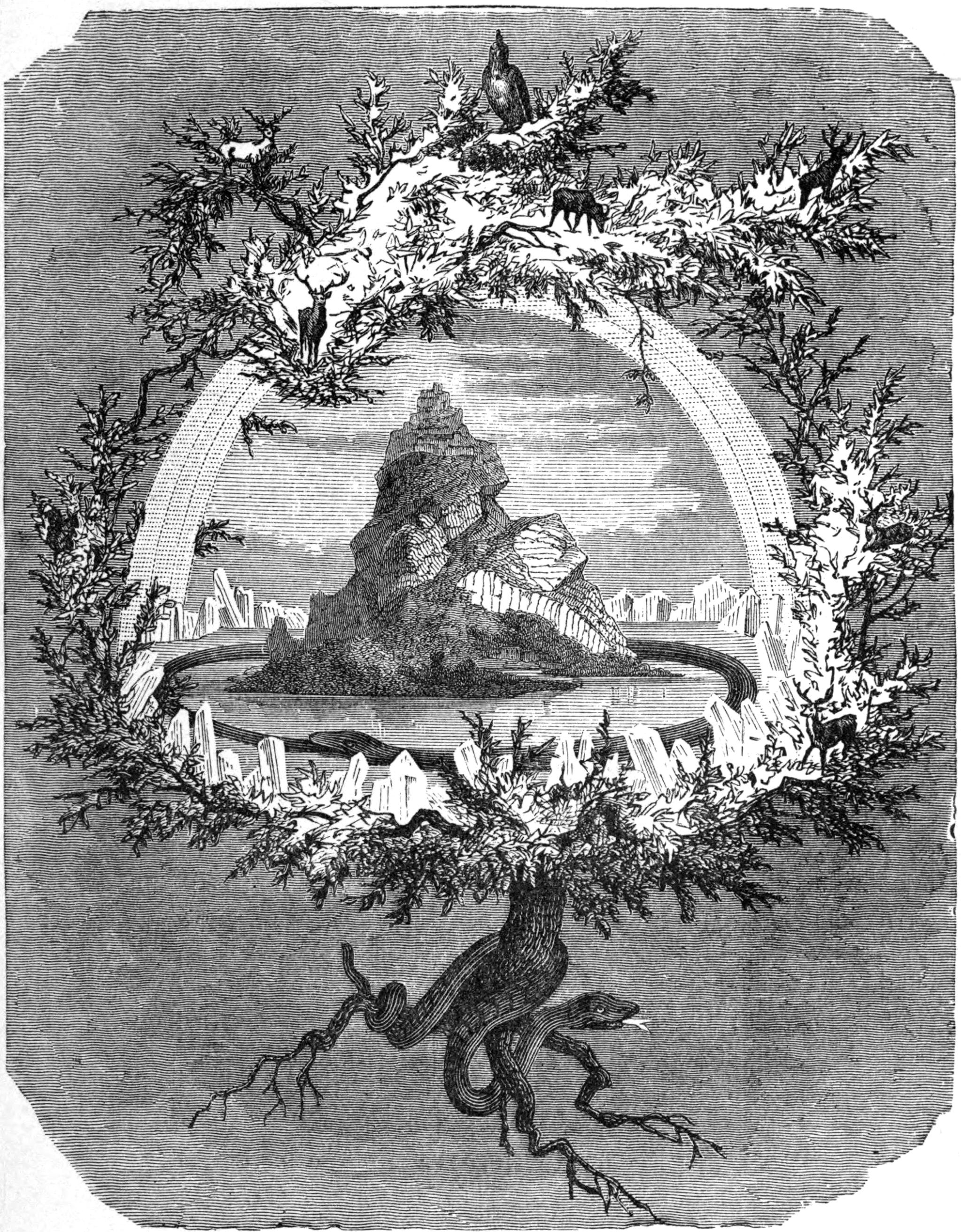
The Northern Mysteries are constructed outwardly around the central premise of the world tree, Yggdrasil, which encompasses all that does, or may ever exist in its roots and branches. Upon this venerable tree rests an interwoven complex of nine distinct realms. These are best understood as overlapping “spheres,” or modes of living reality that interpenetrate one another, together forming a recognizable world.
At its center stands Midgard, the physical plane of ordinary human experience. Note that “ordinary” does not at all mean un-magickal. On the contrary, it is the only realm in which all nine spheres commingle, and for that reason it is undisputedly the most important. Evolution of the soul can only possibly take place here, and the physical body is a temporary anchor designed for that purpose. For this reason, beings from the other eight realms, including the gods themselves, are also deeply interested in it. They continually phase in and out of Midgard, to varying degrees, trying to interact with what we mortals often take for granted. It is the sacred place sought by the dwellers of sacred places. This world is the crossroads.
Above Midgard, in frequency, lie two finer realms. Álfheim occupies the ethereal veil, denser than pure astral substance, yet finer than any material element. Its inhabitants, the elves, are ethereal, meaning they may occasionally be perceived by a trained or gifted eye, but they possess neither weight nor mass as we understand it. They may, and often do, pass in and out of our perceptible reality in such a way as their purposes and abilities allow. When they appear, they do so in a form resembling living light. They are visible when in what we like to call the “magickal headspace,” and are irresistibly enticed by the energy exuded by a confident Vitki during ritual.
Higher still is Asgard, home of the Æsir gods, a realm of pure mind-substance. Their realm is finer even than the ether, normally imperceptible to waking consciousness.
Below Midgard, the density increases and the order of consciousness descends. Svartálfheim, also called Niðavellir, is the home of the dark elves, or dwarfs. These are master manifesters and craftsmen who put the visible world together with spectacular skill. Their symbolic residence “underground” points less to any physical geography than to a lower order of awareness. Their experience of reality is crystalline, three-dimensional, closer to the order of mineral or the automaton than anything we experience here above. Consequently, by our standards they can be petty and are sometimes outwitted by cunning. Stories featuring dwarves often end in their misfortune, with a crafty protagonist getting the better of them and gaining a goodly hoard of loot.
Lowest of all is Hel, the land of the sleeping dead, the realm of the lowest frequency of consciousness. It is the silence that answers when we look up into the night sky and ask, “Is this it?” We experience this slowest of vibrations only in the quietest depths of the sleep cycle. If we are awakened from deep sleep, we are startled and agitated, longing to return to the dark, silent unconscious. It is the same with those who dwell here.
The remaining four realms are spread upon the same horizontal plane as Midgard and correspond to the classical elements. To the north lies Niflheim, the world of frost and ice. To the south, Muspelheim, the world of primal fire. Together, they form a habitable zone that later becomes Midgard.
Eastward is Jötunheim, associated with air, represented by distant mountain peaks and the expansive, often chaotic forces of the giants abiding there. Westward is Vanaheim, linked with water and the generative powers of the Vanir gods, whose love is always for the sea.
Before we go further, it bears repeating that this model is related to, but distinct from, the one used in Western ceremonial magick. Those familiar with the latter will immediately notice the departures from the system they are used to, and are entreated to keep in mind that these departures are intentional, being outworkings from the Nordic cosmological model.
Yggdrasil. The very sound of the word should evoke both beauty-stricken awe and an undercurrent of dread. It translates literally to “horse of the terrible one,” a poetic reference both to Odin’s horse Sleipnir (literally “slipper,” between worlds) and the climactic self-sacrifice of the Allfather by hanging from the tree of worlds. The ritual space is a deliberately planned microcosm of this all-encompassing, deadly-beautiful structure. The four elemental realms are each anchored by a physical implement, placed at its corresponding quarter. These items serve as anchors that give the horizontal plane of the working space its stability and definition.
Teutonic blood cannot be coerced, but it can be appealed to logically. We cannot demand that you use these specific implements. Substitutions are available, provided there’s a good reason. What we can tell you is that this configuration works very well in the context of our native worldview.
…..
Niflheim: North. Whetstone. It is hardness personified, passive but deadly, indeed a giant slayer in the hand of a cunning Bǫlverkr. It represents the frozen ground of winter, and the deep contemplation attended by it.
Muspelheim: South. Blade. Opposite and complementary to the stone, it is the distillation of a shape forged in fire and used with the precise, controlled fury of the noble asserting dominance in his realm. It corresponds with high summer and the youthful energy of life’s prime.
Jötunheim: East. Wand. This is the living, physical body of Gungnir, Odin’s spear, whose element is Wind, thrown from east to west, stirring strife. The air element is of the intellect. With exact precision is the wand pointed, aimed in unchallenged, inexorable command by the master of the circle; the spear never misses its mark when thrown. Who will challenge the king in the vector of his wrath? None.
Vanaheim: West. Cup. Opposite the spear, it is the vessel of the mingled spittle of the gods, ending the struggle. It is the living body of all emotion, standing balanced, poised to issue the silent command only spoken in the deep stillness of a placid, royal countenance. This is the true feminine power behind all.
…..
The vertical axis, running from the densest underworld up through Midgard and into the higher realms of mind and spirit, through the magician’s own body. By the garments he chooses, he invokes them.
For the choice of raiment when in the Midgard circle, consider the iconic appearance of Odin carefully: a long coat, blue as the pallor of the grave; a wide-brimmed slouch hat, pulled low over the face; an eye covering; a self-multiplying ring of dwarven gold.
Now, consider how these attributes invoke the higher and lower realms simultaneously:
Asgard: the wide-brimmed hat. Let it be made of wool or felt, as these are conductive materials that will pull the life current toward the top of the head. The brim will aid in attaining the trance state by shutting away what remains of the mundane world from your attention.
Álfheim: the eyepatch. The left eye looks out into the world while the right looks into the well of Mímir. This is a secret for the wise: covering the right eye makes it easier to see the ethereal veil and the things moving before and beyond.
Midgard: the circle in which you stand. It is the coil of the Midgard Serpent. Cast it with something clearly visible and unbroken on the floor around you. Let it present a clear boundary of your ritual space, outside of which only void prevails.
Svartalfheim: the ring. Let it be of gold, or of a yellow-hued metal if possible. This is a marker of royal status and proclaims divine authority.
Hel: the long coat. Let it be dark blue or black like the night sky. It covers the frame, making you nondescript, shapeless, one with the boundless. It is the mantle of death, for you are doomed, and of the one who transgresses into that country with his ego intact.
He goes about barefoot or with the worn shoes of a wandering beggar. Use your own judgment here. Prefer unobtrusive leather footwear if you need it, uninterrupted contact with the Earth if you need it not. If shoes absolutely must be worn, see that they have many miles on them.
In this arrangement, the tools are elemental, while the bits of ritual garb express the ascending and descending levels of consciousness from Midgard, whose horizontal plane rests at the level of the heart. Every part has a symbolic and an operative function. As the living axis of the World Tree rises within the circle, the space becomes a working model of the entire universe. As within, so without.
Etiquette for Sacramental Items
The physical articles of the Northern Mysteries are individually mysterious, but together holy. Blessed beyond human measure is the Vitki who stands in the Midgard Circle, in the perfect harmony of its every map-rending, venom-spewing part.
This discussion provides only a framework. The specific methods of consecration, charging, and employment belong in closed circles. The methods may be readily available elsewhere, but for reasons you may have guessed, not here.
These are not theatrical props, nor are they badges of rank. It is poor form to make a public show of oneself, less still of the Great Work.
Unless an active working is underway, the articles we have discussed are to remain unseen by those who haven’t any part in it. They may in exception be shown to participants in a shared rite, or to others already bound to the same current, but they are not available to casual curiosity.
There are two exceptions, because of the nature of the forces they carry. The blade (fire) may be worn openly or concealed, according to circumstance. Its corresponding whetstone (frost), if of a size and form that permits it, may be carried in a pocket or hung at the neck. In this way, the twin powers of ice and fire, Niflheim and Muspelheim, remain close at hand while we move through ordinary life. The arrangement is unobtrusive, yet it fulfills a sacred duty, to go about armed.
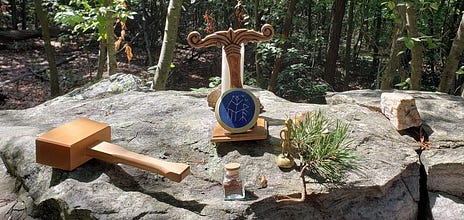
All other implements are kept covered, out of sight when not in use. They may rest upon a dedicated altar, arranged according to the quarters of the working space. When the altar faces north, for example, the preferred orientation, the Wand of the East sits to the right, the Cup of the West to the left. If the altar is turned to another direction, the same relative logic is preserved so that each tool continues to occupy its proper station within the macrocosm. Each weapon rests in its true direction. The precise stage directions matter less than the underlying order.
Photography of these items is likewise restricted. Do not feel comfortable doing this, for it invites all kinds of psychic sludge. Images may be shared with those already inside the current, or with trusted colleagues in the work. Do not circulate them for general viewing.
Still more carefully guarded is the matter of touch. Another person should not handle or wear your ritual implements unless a clear and predetermined reason has been established, and such permission is an extreme exception. The discourtesy is not merely social, but energetic. Consider the touching of the wand or cup of the same order as touching the genitals.
The same principle that forbids ostentation also forbids falsehood. We do not leave the tools on permanent display, yet neither do we lie about their existence or purpose, except in cases of genuine physical danger. If a visitor inquires into some facet of our realm, we do not deflect, but answer in a manner suited to the visitor’s intellect and constitution. Silence and discretion are the ordinary protections; deception is reserved for the interloper.
When the implements are at rest, they should be wrapped or enclosed in an insulating material. Silk serves well. Wool, being conductive, does not. Generally, if you can make a static lightning storm with it, leave it alone as a covering. This helps preserve the charge already laid into the object. It also protects it, screening it from conflicting influences. A properly kept tool, when uncovered in the ritual space, produces a tangible shift in the quality of the silence that surrounds it. It is hard to describe, but just try it. It is a sign that the item has been protected and is ready for use.
The Northern Mysteries hand us a living cosmology. With it, the freedom and the burden of a pioneer. None of these articles is mandatory, in the rigid sense of older ceremonial systems. We would reflexively scoff at it if it were. Instead, they arise, when they arise, through a quiet two-way conversation between the Work and the material anchors it decides to require. Like when we write something down to release an idea caged in the mind, when we condense an eternal, cosmic truth into a physical object, we free our minds to do something finer in the space it provides: real magick.
That freedom is real, and as rewarding as it is, it can still be dangerous. The sacramentals must remain what they are: physical aids to spiritual perfection. Take care that they never become a substitute for that perfection, lest the path lead into a swamp.
Discern, O King. Acquire what the Work calls for. Keep what continues to serve and relinquish what no longer does. Let them be subjects of your realm, and they will be loyal.